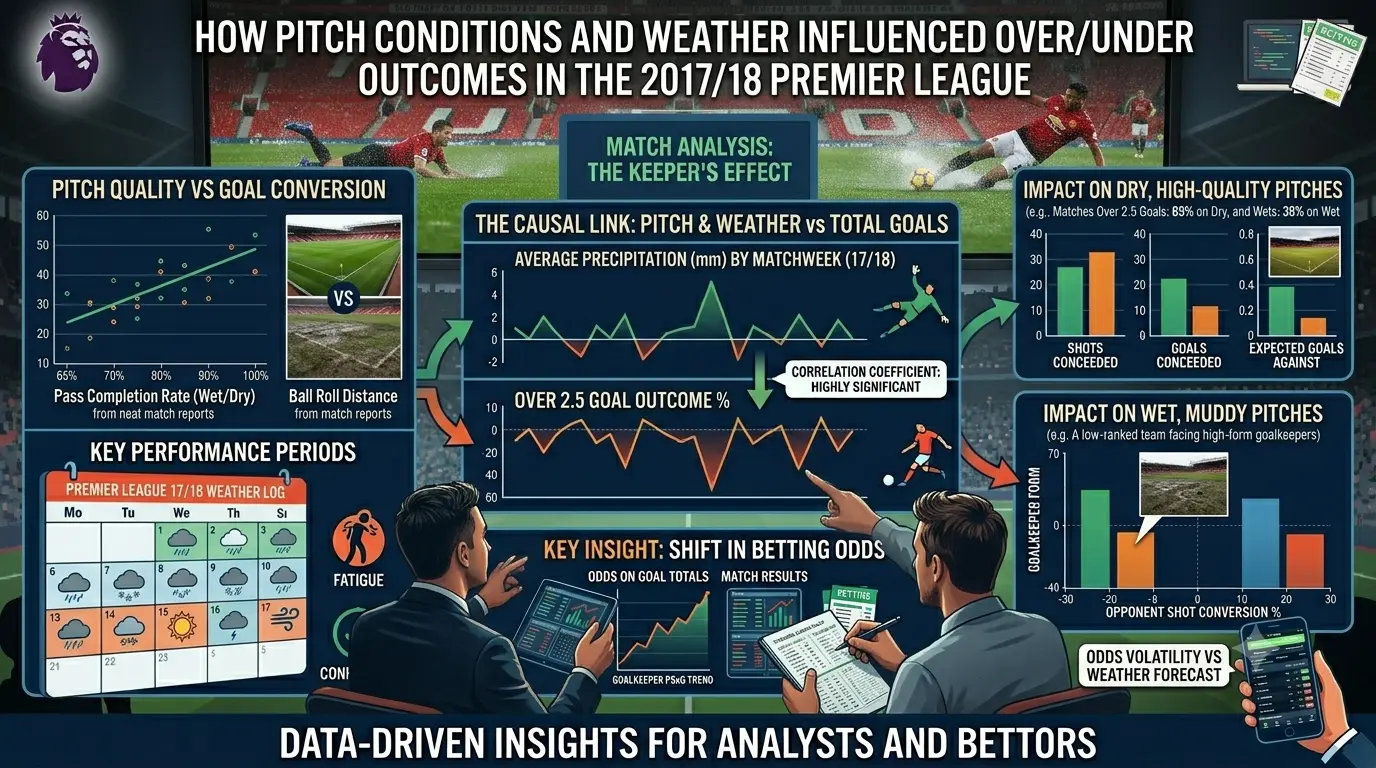
During the 2017/2018 Premier League season, external conditions such as pitch quality and weather played a subtle but measurable role in shaping match tempo and goal output. While often overlooked, these factors directly affected passing accuracy, shot quality, and overall game rhythm—key components in evaluating over/under markets.
Why Environmental Conditions Affect Goal Probability
Football is highly sensitive to surface and weather conditions. A fast, dry pitch supports quick passing and fluid attacking movement, while poor surfaces or adverse weather slow the game and increase errors.
This shift alters chance creation. Faster conditions favor attacking teams and higher shot volumes, while slower or unstable conditions reduce attacking efficiency and increase defensive recovery time.
How Pitch Quality Changes Match Dynamics
Pitch condition influences how teams execute their tactical plans. Even small variations in surface quality can disrupt rhythm.
- Smooth surfaces enable precise passing and quick combinations.
- Uneven pitches increase miscontrols and broken play.
- Wet surfaces accelerate ball speed, favoring direct attacks.
- Heavy pitches slow movement and reduce tempo.
These differences shape the flow of the match. A team built on technical passing may struggle on a poor surface, while a direct team may benefit from reduced reliance on precision.
The outcome is context-dependent. The same teams can produce very different scoring patterns depending on pitch condition.
Weather Effects on Playing Style
Weather introduces additional variability by influencing both physical performance and ball behavior.
Key weather impacts
- Rain increases ball speed but reduces control.
- Wind affects long passes and shooting accuracy.
- Cold temperatures reduce player endurance over time.
These factors interact with team style. For example, wind can disrupt crossing teams, while rain may benefit counterattacking sides by speeding up transitions.
Understanding these interactions helps explain why goal patterns shift under different conditions.
Translating Conditions Into Over/Under Expectations
Environmental factors directly influence total goal probability by affecting both chance creation and finishing efficiency.
Observation indicates that when evaluating matches through a sports betting service such as ยูฟ่า168, environmental conditions are not always fully reflected in goal-line pricing. Matches played under adverse conditions may still be priced based on typical scoring patterns, creating discrepancies between expected and actual outcomes.
When Weather Increases Scoring Instead of Reducing It
While poor conditions often suppress goals, certain scenarios produce the opposite effect.
- Defensive errors increase on slippery surfaces.
- Goalkeeper handling becomes less reliable in rain.
- Faster ball movement creates unexpected scoring chances.
These situations introduce volatility. Instead of reducing scoring, they can lead to unpredictable, high-scoring matches.
Recognizing when conditions create chaos rather than control is essential for accurate interpretation.
Comparing Stable vs Disruptive Conditions
Different environmental setups produce distinct scoring environments.
Condition type | Characteristics | Impact
Stable conditions | Dry pitch, minimal wind | Predictable, balanced scoring
Disruptive conditions | Rain, wind, poor surface | Increased variability in outcomes
This comparison highlights that environmental stability supports consistency, while disruption increases unpredictability.
Market Interpretation and Overlooked Variables
Markets often prioritize team statistics and recent form while underweighting environmental context. This creates blind spots, particularly in goal-related markets.
Within a casino online environment, where multiple betting categories compete for attention, these nuances may be simplified. As a result, environmental factors may not be fully incorporated into pricing models, especially for mid-level fixtures.
Integrating Weather and Pitch Data With Team Analysis
To improve accuracy, environmental factors should be combined with team-specific characteristics such as playing style and adaptability.
For example, a possession-based team may struggle more on a poor pitch than a direct team. Similarly, a team reliant on long passes may be more affected by wind conditions.
This layered approach allows for more precise prediction of how conditions will influence match outcomes.
Limitations of Environmental Analysis
While influential, pitch and weather conditions do not determine results on their own. Several factors limit their impact.
- High-quality teams can adapt to adverse conditions.
- Individual moments of skill can override environmental constraints.
- Match context, such as scoreline, can change tactical behavior.
These limitations emphasize that environmental analysis should complement, not replace, core evaluation.
Practical Indicators to Monitor
Before applying environmental insights, bettors should focus on specific indicators that signal meaningful impact.
- Pre-match weather forecasts for wind and precipitation.
- Reports on pitch condition from recent matches.
- Historical performance of teams under similar conditions.
These indicators provide actionable context. Without them, environmental analysis risks becoming speculative.
The interpretation of these signals should always be tied to how they affect match dynamics rather than treated as isolated data points.
Summary
Pitch conditions and weather during the 2017/2018 Premier League season influenced match tempo, chance creation, and goal outcomes. By understanding how environmental factors interact with team style and execution, bettors can better interpret over/under markets and identify situations where expectations diverge from reality.